
Symposia
ISO Technical Specification for Tea Chemical Classification Officially Released

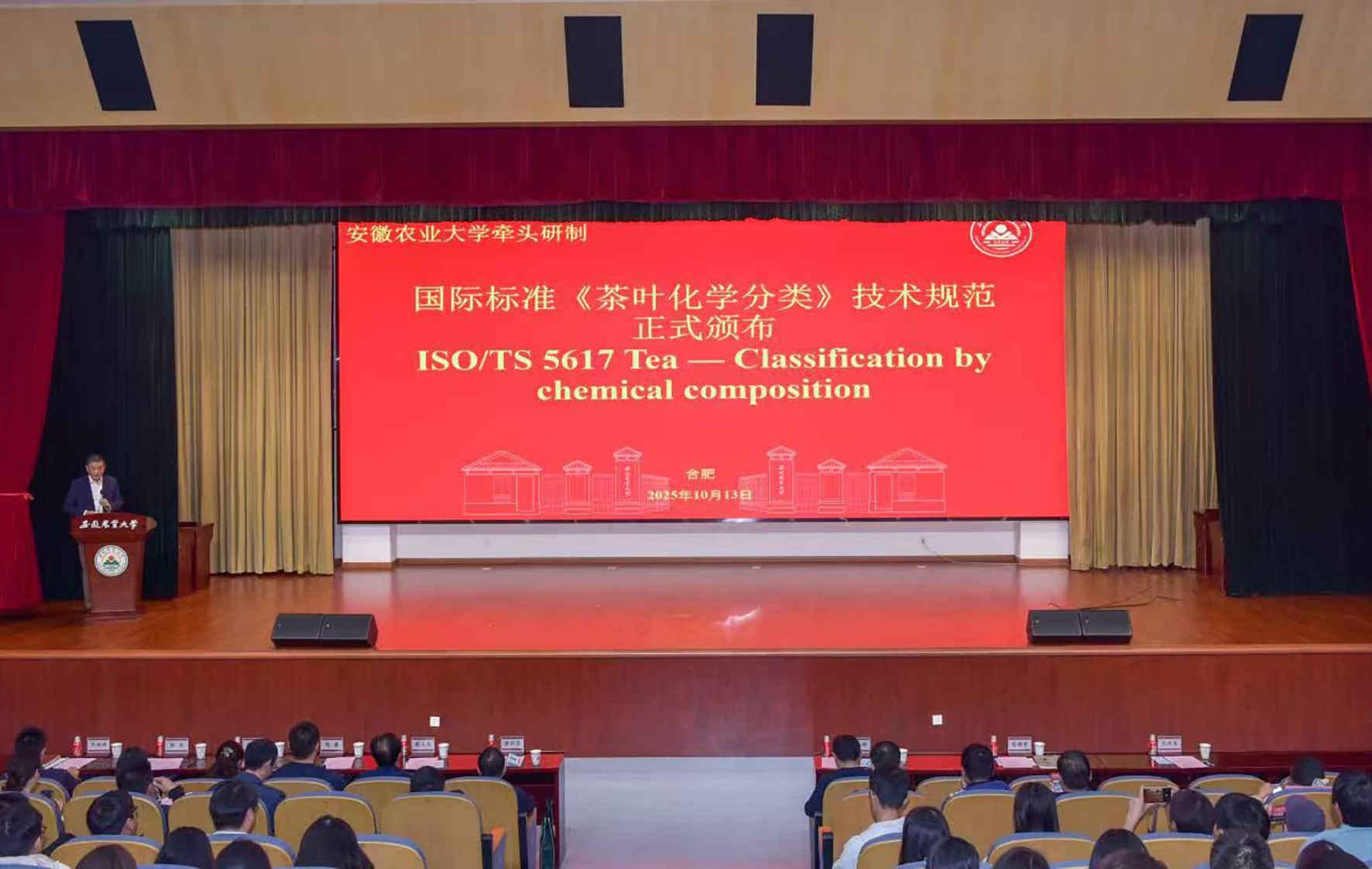
Recently, the International Organization for Standardization (ISO) officially released the Technical Specification Tea — Classification by chemical composition (ISO/TS 5617:2025). This standard was developed under the leadership of Professor Wan Xiaochun, Deputy Director of the Tea Committee of the Chinese Society for Horticultural Science and Director of the State Key Laboratory of Tea Plant Germplasm Innovation and Resource Utilization at Anhui Agricultural University. It represents another significant achievement by China in the field of international tea standardization.
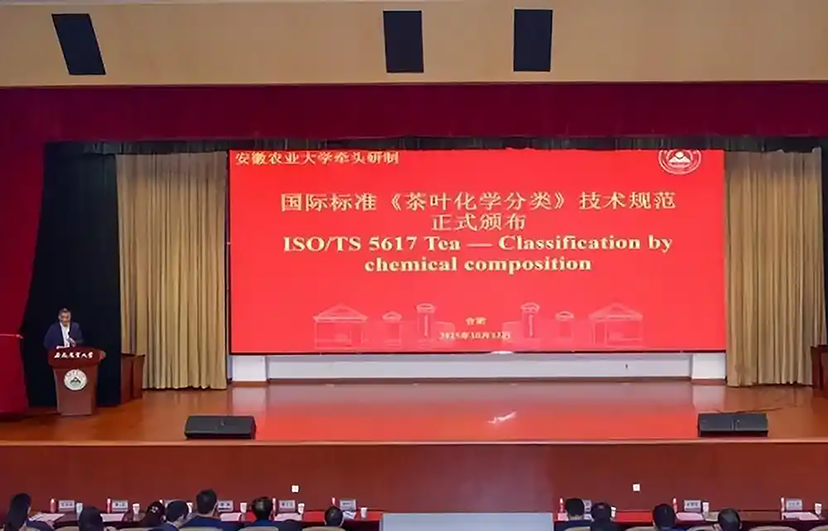
The standard is based on China's existing national standard GB/T 35825-2018 Tea — Classification by chemical composition, systematically integrating chemical analysis with multivariate statistical methods. On the basis of in-depth elucidation of the transformation patterns of characteristic tea components during processing, the standard clarifies the distribution patterns of key chemical components—including caffeine, catechins, and theanine—across the six major tea categories. It identifies six key discriminant factors and establishes a classification system based on Fisher's discriminant model and stepwise discriminant analysis, providing a "chemical ruler" for tea classification—one that can objectively distinguish green tea, black tea, oolong (blue) tea, white tea, yellow tea, and dark tea using data.
This is another breakthrough in international tea standardization following China's leading role in the release of Tea — Classification of tea types (ISO 20715:2023) in 2023, further strengthening China's international influence in tea classification methodologies.
Professor Wan Xiaochun explained that the Tea — Classification by chemical composition standard complements the Tea — Classification of tea types standard. The two standards approach classification from different perspectives—chemical composition versus processing technology and quality characteristics—providing a more comprehensive and scientific technical basis for international tea trade, research and education, and quality supervision.
"The release of these two standards signifies that China's scientific tea classification system has gained international recognition. This will effectively advance the technological and international development of China's tea industry and reduce trade disputes arising from differences in standards," said Professor Wan. He added that the standard will also facilitate better access to international markets for distinctive Chinese tea categories such as white tea, yellow tea, and dark tea, while enhancing China's influence in tea research, standardization, and international dissemination of tea culture, thereby contributing to the Belt and Road Initiative.
During the standard development process, substantial support was provided by the Standardization Administration of China, the National Technical Committee 339 on Tea of Standardization Administration of China (SAC/TC339), the Hangzhou Tea Research Institute of All-China Federation of Supply and Marketing Cooperatives-, the China Tea Marketing Association (CTMA), and Fujian Agriculture and Forestry University, among other relevant organizations.
Professor Wan Xiaochun has devoted over 40 years to in-depth research on tea quality theory and technological innovation. To address bottlenecks constraining the traditional tea processing—such as unstable quality and low efficiency—he has constructed a gene bank of Chinese tea plant germplasm and systematically elucidated the mechanisms of formation and transformation of tea quality components. He has developed automated tea processing and digital quality control technologies, and created China's first automated tea production line. As head of the Chinese delegation to the ISO technical subcommittee on tea standardization for 16 years, he has led the development of international standards including Tea — Classification of tea types and Tea — Classification by chemical composition, breaking the long-standing monopoly of European and American countries in this field. He has also spearheaded the establishment of a state key laboratory for tea science, cultivated a first-class innovation team, and served the national tea industry, making outstanding contributions to tea quality improvement and processing modernization in China. As the first author, he has received one second-class National Science and Technology Progress Award (2020) and three first-class provincial and ministerial science and technology awards. He has led 39 major national and provincial research projects, including those under the National Key Technology R&D Program and the 973 Program. He holds 62 authorized invention patents and has published 275 high-quality papers in leading journals such as PNAS and Molecular Plant, with 10,929 citations and an H-index of 61—the only researcher in the tea field to be named a Clarivate Highly Cited Researcher. His honors include the First-Class Merit Award for "Outstanding Professional and Technical Talent" from the Ministry of Personnel (1999), the Anhui Provincial Major Science and Technology Achievement Award (2022), and the National Innovation Excellence Award (2023).